Supercritical fluid chromatography with UV detection
The separation that can tell two mirror images apart — and the only one here that can, because on every other column they are the same compound.
- Cited on certificates as
- SFC-UV
- Standard
- —
- Reports
- Enantiomeric excess · Diastereomer and isomer separation · Purity of low-polarity compounds
What SFC is
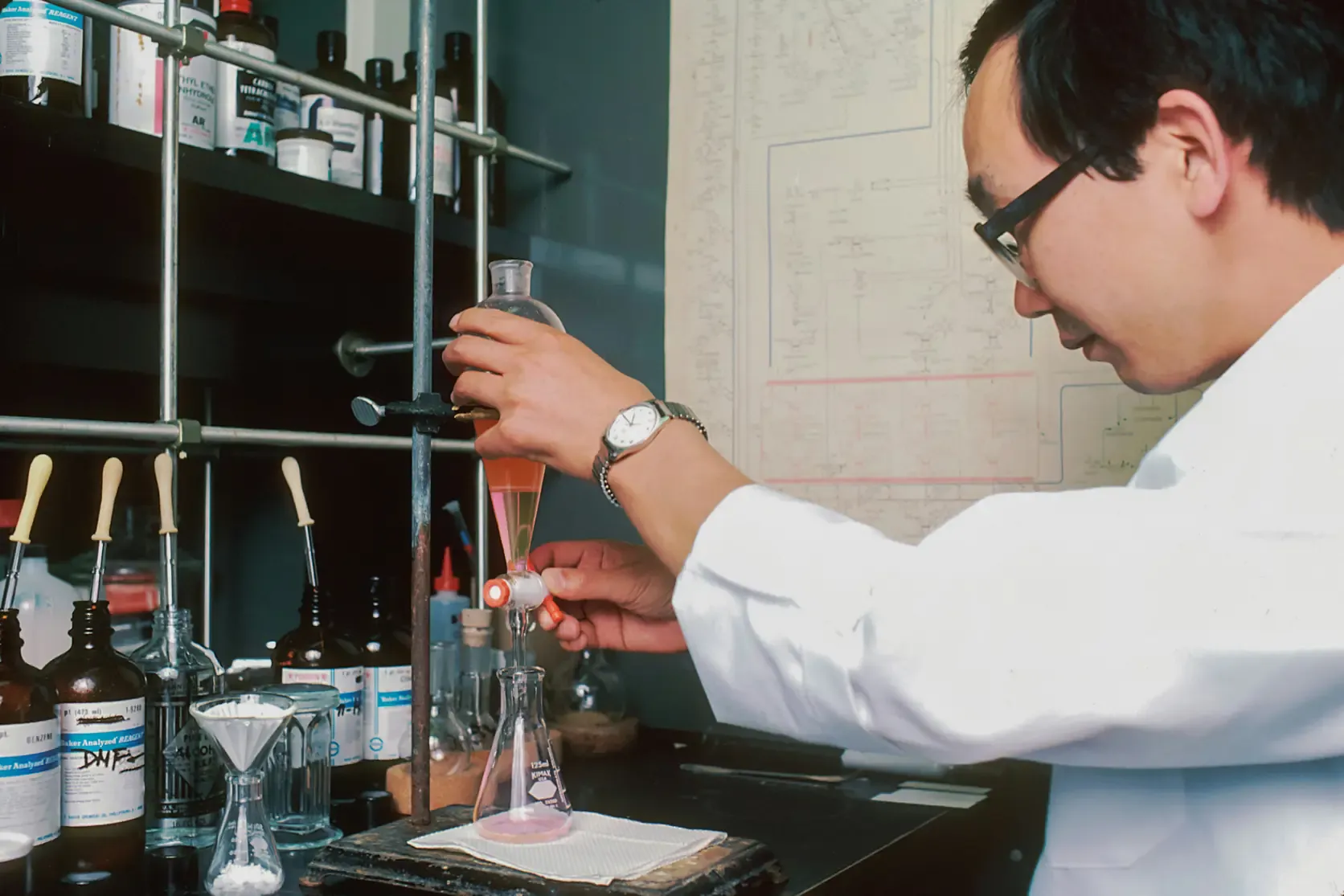
Supercritical fluid chromatography is liquid chromatography with the solvent mostly replaced by carbon dioxide. Held above its critical point — 31 °C and about 74 bar — carbon dioxide is neither a gas nor a liquid: it dissolves things the way a liquid does while diffusing through a packed column almost the way a gas does. A small amount of alcohol, usually methanol, is added to carry anything the carbon dioxide alone cannot.
What that buys is speed at the same resolution. Because mass transfer is fast, the column can be run several times harder than a liquid method without the peaks broadening the way they would, and a separation that takes half an hour by HPLC often takes a few minutes here. The pressure is not an operating detail but the method itself: a backpressure regulator holds the fluid dense, and letting it fall changes the separation rather than merely slowing it.
On this site the reason it matters is chirality. Two enantiomers — the same molecule built as left and right hands — have identical mass, identical UV absorbance and identical retention on an ordinary column, so neither the HPLC method nor the mass spectrometer can distinguish them. A chiral stationary phase holds one hand slightly longer than the other, and that difference is the whole measurement.
As stated on a certificateSeparation on a chiral stationary phase with supercritical carbon dioxide and an alcohol co-solvent as the mobile phase, resolving enantiomers and quantifying their ratio by UV absorbance.
How it works
The mobile phase
Carbon dioxide is pumped as a chilled liquid and brought above its critical point by the pressure in the system. A second pump adds the co-solvent, typically methanol with a trace of an acid or a base, and the proportion of that co-solvent is what a gradient varies.
The chiral column
The stationary phase is a polysaccharide derivative — amylose or cellulose, coated or bonded onto silica — whose own handedness is what makes it hold one enantiomer longer than the other. Which phase resolves a given pair is not predictable, so method development is a screen across several columns rather than a calculation.
Separation
The two enantiomers leave the column at different times. The difference is often small, and it is the whole result: a pair that co-elutes reports as one peak and one peak says nothing about which hand it is.
Backpressure and temperature
Both are held to the method. Density is a function of pressure and temperature, and solvating power follows density, so retention here moves with conditions more than it does in a liquid method. A figure is comparable only against a standard run under the same pressure and the same temperature.
Detection
UV absorbance, read in a cell built to hold the pressure. The carbon dioxide leaves as a gas when the pressure drops after the detector, which is also why the outlet couples to a mass spectrometer with less trouble than a liquid one does.
Reading what it produces
- Two peaks with areas of 99 and 1 are 98% ee, not 99%. Enantiomeric excess is the difference between the two, not the size of the larger: the minor enantiomer cancels an equal amount of the major, which is what the word excess means. Reading ee% off the larger peak overstates it, and the error grows as the sample gets worse.
- Which peak is which is not in the chromatogram. The column reports that two things separated and in what ratio; assigning a configuration to a peak needs a reference standard of known configuration run under the same conditions, and without one the result is a ratio of unnamed hands.
- Retention shifts with backpressure and temperature more than a liquid method does. A chromatogram compared against one run under other conditions is being compared against a different method.
What we report from it
Every one of these is a measurement made in this laboratory on the sample as received. The certificate names the method behind each figure, because the method is most of what the figure is worth.
- Enantiomeric excess
- The ratio of the two enantiomers, usually written as ee% or as an enantiomeric ratio. It is the determination this method exists for and the one no other method here can make.
- Diastereomer and isomer separation
- Positional isomers and diastereomers that co-elute on a reversed-phase column, resolved by a different selectivity.
- Purity of low-polarity compounds
- Related substances in lipophilic material that a water-based method retains poorly or not at all.
The instrument
What a laboratory running this method has on the bench, and what each part decides about the result.
- CO₂ pump
- Delivers carbon dioxide chilled to keep it liquid at the pump head. Its stability sets the stability of everything downstream.
- Co-solvent pump
- Adds methanol or another alcohol, with any additive, and runs the gradient that varies it.
- Chiral column
- The separation. A polysaccharide phase whose own handedness holds one enantiomer longer than the other.
- Column oven
- Holds temperature, which with pressure sets the density of the mobile phase and so its solvating power.
- Backpressure regulator
- Keeps the fluid above its critical point through the whole flow path. It is a method parameter, not a valve that is simply open.
- High-pressure UV cell
- Reads absorbance without letting the mobile phase decompress, which would put a gas bubble in the light path.
The detector decides what is visible
The column separates; the detector is what turns that separation into a number. It is also the half a method name mentions only in passing — the -UV in RP-HPLC-UV is not a suffix, it is the reason the purity figure is an area percentage at one wavelength. Every detector is blind to something, and what it cannot see does not appear on the chromatogram however much of it is there.
Ultraviolet / diode array
- Sees
- Anything with a chromophore, in a cell built to hold system pressure. A diode array records a full spectrum at each point, which helps show whether a peak is one component or two badly resolved ones.
- Blind to
- Compounds with no chromophore, exactly as in liquid chromatography. It also cannot tell you which enantiomer a peak is: both absorb identically, which is the whole difficulty.
Mass spectrometry
- Sees
- Mass-to-charge ratio. It couples more easily here than to a liquid method, because the mobile phase turns to gas on decompression and largely removes itself before the source.
- Blind to
- The difference between enantiomers, which have the same mass and the same fragments. It confirms what the peaks are; the column is what separated them.
Evaporative light scattering / charged aerosol
- Sees
- Anything less volatile than the mobile phase, so compounds that absorb nothing at all still register.
- Blind to
- Volatile analytes, and its response is not linear with concentration, so quantitation needs a calibration curve rather than an area ratio.
Circular dichroism
- Sees
- The sign of the optical response, which is the one signal that differs between enantiomers. It can indicate which hand a peak is without a reference standard of known configuration.
- Blind to
- Anything not optically active, and it is far less sensitive than UV, so it is read alongside an absorbance trace rather than instead of one.
What it cannot establish
This list is the reason the rest of the page is worth reading. A figure, or an observation, means what its method can support and nothing past it.
- 01Enantiomeric excess is not chemical purity, and the two are routinely confused. A sample can be 100% ee and still be half solvent, half degradant or the wrong compound entirely: ee describes the ratio between two mirror images and says nothing about anything else in the vial. A certificate carrying ee% and no purity figure has reported one thing, not two.
- 02The chromatogram does not name which enantiomer is which. Without a reference standard of known configuration run under the same conditions, the result is the ratio of two unassigned peaks, and a certificate should say so rather than assert a configuration the data does not carry.
- 03Peptides are largely outside it. They are polar, they are large, and the chiral question for a peptide is usually about the configuration of individual residues, which is answered by hydrolysis and amino-acid analysis rather than by putting the intact peptide on a chiral column.
- 04A pair that does not resolve reports as one peak, and one peak is not evidence of a single enantiomer. A method that has not been shown to separate a racemic standard cannot support a statement about ee at all.
- 05It says nothing about water, counter-ion, endotoxin or biological potency, exactly as the other methods here do not.
Where it is used
- Enantiomeric excess of a chiral active substance or intermediate
- Diastereomer and positional isomer separation where reversed-phase selectivity is insufficient
- Related substances in lipophilic or weakly polar material
- Method screening, where several columns and conditions are compared quickly
- An orthogonal check on a purity figure produced by a liquid method
Questions people arrive with
Asked about SFC often enough to be worth answering here rather than by return of email.
Anything else, and the answer comes from a person rather than a page. Write to the laboratory.
What is supercritical fluid chromatography?
A separation whose mobile phase is carbon dioxide held above its critical point, with an alcohol added, instead of the water and organic solvent a liquid method uses. In that state carbon dioxide dissolves like a liquid and diffuses nearly like a gas, so a column can be run much faster without the loss of resolution that speed normally costs. Most of its use is chiral separation.
Why is it used for chiral compounds?
Because the separation is hard to predict and therefore has to be searched for. Which chiral stationary phase resolves a given pair of enantiomers cannot be calculated, so method development means screening several columns and several co-solvents, and a technique whose runs take minutes instead of half an hour turns that search from a week into a day. The chemistry is not better than chiral HPLC; there is simply more of it per day.
Does a 99% ee figure mean the sample is 99% pure?
No, and this is the most common misreading of the number. Enantiomeric excess describes the ratio between two mirror images of one compound. It is silent about solvent, water, degradants, counter-ion and every other substance present, so a sample can be 100% ee and chemically filthy. Chemical purity is a separate determination from a separate method, and a certificate reports them as separate lines.
How do I choose between SFC and HPLC?
By the question rather than the platform. For most purity and assay work a reversed-phase liquid method is the appropriate and better-established route. SFC earns its place where liquid chromatography struggles: enantiomers, closely related isomers, and compounds too lipophilic to retain sensibly in a water-based mobile phase. The honest answer is that they are complementary and that committing to either before knowing what the molecule does is the mistake.
Is this method run at ZEIKKA?
Yes, for chiral work. Where a certificate reports enantiomeric excess without naming which enantiomer is in excess, it says so: assigning a configuration needs a reference standard of known configuration, and a certificate should not assert one the run did not establish.
Also cited on certificates
HPLC
The separation most purity figures begin as: a mixture pushed through a column, and a detector recording what comes off and when.
LC-MS/MS
A chromatographic separation feeding a mass spectrometer, so a component can be weighed rather than only timed.
GC
The separation for things that will travel as a vapour — residual solvents above all, which is the line a purity figure by HPLC cannot fill in.
SEM
The method that produces a picture rather than a number — and the one whose result depends most on how the sample was chosen.
Holding a certificate that cites SFC-UV?
Check its number against our record. No account, and the same check is open to anyone holding the document.